how much personal loan can I get with a ₹30,000 salary?

on ₹30,000 per month, personal loan amounts usually fall between ₹3.5 lakh and ₹7 lakh. which lender, credit score, and existing obligations all play a role.
lenders apply the Fixed Obligation to Income Ratio, or FOIR. this compares existing monthly commitments, EMIs on other loans, credit card bills, rent, to gross monthly income. most lenders set the FOIR cap at 40 to 50%. for someone earning ₹30,000, that means the total EMI of all loans combined cannot exceed ₹12,000 to ₹15,000 per month.
what the minimum salary requirement actually means
banks publish minimum monthly income figures for personal loan eligibility. for salaried employees in metro cities, the number typically sits at ₹20,000 to ₹25,000 per month. some banks require ₹30,000 for non-salary account holders.
hitting that minimum only prevents auto-rejection. it does not guarantee approval. it also does not determine the final loan amount.
borrowers earning ₹30,000 fall into the mid-salaried bracket. most lenders, public sector banks, private banks, and non-banking financial companies (NBFCs), accept applications at this income level. the actual loan amount depends on affordability, not the salary figure alone.
why a ₹30,000 salary doesn't tell the whole story
the math behind the loan amount
the loan amount comes from disposable income: what remains after existing equated monthly instalments (EMIs) get deducted.
the FOIR formula
FOIR = (Total Monthly Obligations ÷ Gross Monthly Income) × 100
total monthly obligations cover:
- existing loan EMIs
- credit card minimum payments
- other fixed monthly commitments
at ₹30,000 monthly income with no existing obligations, the maximum affordable EMI at 50% fixed obligation to income ratio (FOIR) works out to ₹15,000.
how that translates to loan amount
at 10.5 to 12% interest per annum, a ₹15,000 EMI over 5 years supports roughly ₹7 to 7.5 lakh. at 18% per annum, the same EMI supports about ₹5.5 lakh over 5 years.
example calculation:
| scenario | monthly income | existing EMI | disposable income | approx loan amount (5 yrs @ 12%) |
|---|---|---|---|---|
| no existing debt | ₹30,000 | ₹0 | ₹15,000 | ₹6.5 to 7 lakh |
| car loan EMI ₹5,000 | ₹30,000 | ₹5,000 | ₹10,000 | ₹4.5 lakh |
| two existing EMIs ₹8,000 | ₹30,000 | ₹8,000 | ₹7,000 | ₹3 to 3.5 lakh |
what lenders check beyond salary
credit score
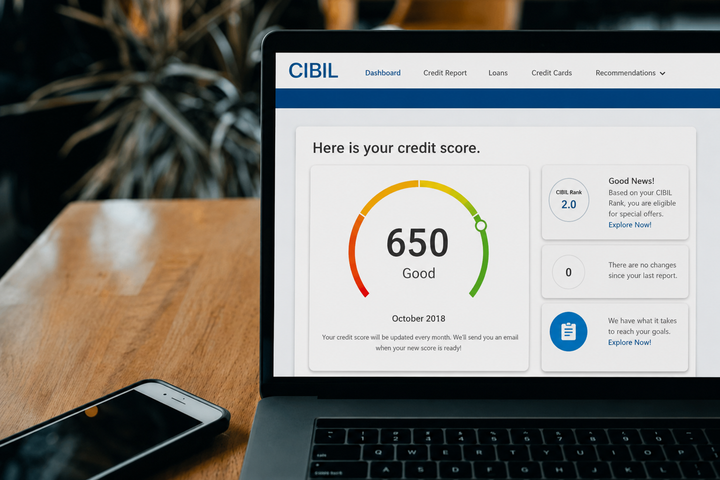
most lenders want a credit information bureau (India) limited (CIBIL) score of 700 or higher. some accept 650+ but charge higher interest. a clean repayment history carries more weight than the salary figure. a borrower earning ₹30,000 with a 780 score and no defaults looks safer than someone earning ₹50,000 with missed payments on record.
employment stability
banks prefer stable employment. at least one year in the current job is typically required. A ₹30,000 salary from the same employer for two years looks safer than a ₹50,000 salary with frequent job changes. for self-employed professionals, banks average two to three years of income and apply stricter scrutiny.
age and tenure
applicants must typically be between 21 and 60 years of age. borrowers closer to retirement face shorter loan tenures, which increases the EMI and can reduce eligibility. A 58-year-old borrower may not qualify for a 5-year loan, even with the same income.
how much a ₹30,000 salary supports: four lenders compared
different lenders apply different multiples to income. based on published estimates, here is how ₹30,000 salary translates across lender types:
| lender Type | interest rate | processing time | CIBIL requirement | estimated loan amount (₹30k salary, clean profile) |
|---|---|---|---|---|
| public sector banks (SBI) | 11.05 to 14.56% | 3 to 5 working days | 650+ | ₹3.5 to 5 lakh |
| private banks (HDFC, ICICI, Axis) | 10.49 to 16% | 24 to 48 hours | 700+ | ₹5 to 7 lakh |
| NBFCs (Bajaj, Tata, Fullerton) | 11 to 28% | 24 to 48 hours | 685 to 700+ | ₹4 to 6 lakh |
| fintech apps | 9.9 to 45% | minutes to hours | 650+ | ₹2 to 4 lakh |
source: Kotak Bank estimate shows approximately ₹7.09 lakh for a clean profile at Kotak
the wide range reflects variations in credit score, employment stability, and the lender's risk appetite.
how useful is a ₹30,000 salary for a personal loan really?
| use Case | loan Amount | EMI (5 yrs @ 12%) | FOIR | feasibility |
|---|---|---|---|---|
| small emergency (medical, travel) | ₹2 lakh | ₹4,450 | 15% | highly feasible |
| mid-sized expense (wedding, home renovation) | ₹4 lakh | ₹8,900 | 30% | feasible |
| large expense (vehicle down payment) | ₹6 lakh | ₹13,350 | 44.5% | stretching it |
| maximum eligibility | ₹7 lakh+ | ₹15,000+ | 50%+ | risky |
source: Calculations based on 12% interest, 5-year tenure
the key thing to note: just because a lender says yes to ₹7 lakh doesn't mean a borrower should take it. A ₹15,000 EMI on a ₹30,000 salary leaves only ₹15,000 for all other expenses: rent, groceries, utilities, transport, and savings. one unexpected expense can create significant financial stress.
when approval does not mean the loan is affordable
the bank's approval amount is not the same as what is financially comfortable to borrow. the bank approves the maximum it can safely recover. that number does not always match what makes financial sense for the borrower.
borrowers with a ₹30,000 salary should consider:
- existing EMIs: if monthly obligations already exceed 40% of income, adding another loan increases stress. at 50% FOIR, one unexpected expense can create financial strain.
- total interest cost: A ₹4 lakh loan at 12% over 3 years costs about ₹78,000 in interest. over 5 years, that number jumps to ₹1.34 lakh.
- emergency buffer: The EMI should leave room for savings and unexpected expenses. the 35% FOIR range (₹10,500) leaves more breathing room than the 50% limit (₹15,000).
common mistakes borrowers make with a ₹30,000 salary
applying for the maximum amount
borrowers who apply for ₹5 lakh when their FOIR realistically supports ₹2.5 lakh often face rejection. a rejected application itself can affect future applications.
multiple simultaneous applications
each formal loan application triggers a hard enquiry on the credit report. multiple enquiries in a short period can lower the CIBIL score by 5 to 10 points per enquiry.
ignoring the processing fee
A 1 to 3% processing fee on a ₹3 lakh loan adds ₹3,000 to 9,000 plus goods and services tax (GST). this cost is easy to overlook when comparing headline rates.
choosing tenure by EMI alone
A 60-month tenure lowers the EMI but can nearly double the total interest paid compared to a 24-month tenure on the same amount.
frequently asked questions
1. what is the maximum personal loan amount for a ₹30,000 salary with no existing loans?
with no existing EMIs, a borrower can typically get between ₹6.5 lakh and ₹7.5 lakh, depending on the lender and credit score. at 50% FOIR, a ₹15,000 EMI at 12% over 5 years supports approximately ₹7.09 lakh.
2. does having a co-applicant increase the loan amount on a ₹30,000 salary?
adding a co-applicant with a stable income increases the combined household income, which raises the FOIR-based eligibility. many lenders allow spouses or parents as co-applicants to improve loan amounts and approval chances.
3. how much does the interest rate vary for a ₹30,000 salary borrower?
interest rates for a ₹30,000 salary borrower can range from 10.5% to 28% per annum. public sector banks offer the lowest rates (10.5 to 14%), while fintech apps can charge up to 45%. a borrower with a 750+ score gets the lowest rates. someone with a 650 to 700 score pays 2 to 4% higher.
4. can a borrower prepay the personal loan taken on a ₹30,000 salary?
most lenders allow prepayment after 6 to 12 months. a prepayment penalty of 2 to 5% on the outstanding amount usually applies. some lenders, especially NBFCs, charge higher penalties or restrict prepayment entirely. borrowers should check the terms before signing.
5. how does the loan tenure affect the total interest cost on a ₹30,000 salary?
longer tenures lower the EMI but significantly increase total interest. on a ₹4 lakh loan at 12%, a 2-year tenure costs about ₹50,000 in interest. A 5-year tenure costs about ₹1.34 lakh: nearly 2.7 times more. borrowers should match tenure to the purpose and choose the shortest affordable option.