how much top up loan can I get? eligibility, limits and calculation

a top-up loan is additional borrowing on an existing home loan. the same property stays as collateral, with no fresh registration and no new lender, so it amounts to more money against the same asset.
the lender reviews the repayment record. EMIs paid on time for typically 6 to 12 months qualify the borrower. a top-up can be used for almost any purpose, including home renovation, medical emergencies, education, wedding expenses or debt consolidation, though not for speculative activity such as stock trading.
the advantage is the rate, which sits close to home loan rates and well below personal loan rates. the paperwork is minimal, since the lender already holds the know your customer (KYC) records and property documents.
how much can be borrowed
the top-up amount depends on three things: property value, outstanding loan balance, and loan to value (LTV) ratio.
the LTV formula
most lenders cap the total loan, existing plus top-up, at 70 to 80% of the property’s current market value.
lenders apply different LTV ratios based on loan amount. for total loans up to ₹30 lakh, the LTV cap is 90%. for total loans between ₹30 lakh and ₹75 lakh, the cap is 80%. for total loans above ₹75 lakh, the cap is 75%.
bank of Baroda offers top-up loans from ₹1 lakh up to ₹2 crore for NRI/PIOs, with the maximum linked to the remaining tenure of the existing home loan.
worked example
consider a property worth ₹1 crore. outstanding home loan is ₹50 lakh. lender applies an 80% LTV cap.
- maximum total loan allowed: ₹1,00,00,000 × 80% = ₹80,00,000
- outstanding balance: ₹50,00,000
- maximum top-up: ₹80,00,000 to ₹50,00,000 = ₹30,00,000
this matches the Moneycontrol example: a ₹1 crore property and ₹50 lakh outstanding gives a top-up of ₹20 to 30 lakh.
South Indian Bank provides a detailed calculation:
| parameter | calculation | value |
|---|---|---|
| home Loan | given | ₹40 lakhs |
| property Value | given | ₹1 crore |
| value apportioned for HL | ₹40L / 80% | ₹50 lakhs |
| residual Equity | ₹1Cr: ₹50L | ₹50 lakhs |
| top-Up funding | ₹50L × 75% | ₹37.5 lakhs |
LTV limits in India
| total Loan (HL + Top-Up) | maximum LTV | margin |
|---|---|---|
| up to ₹30 lakh | 90% | 10% |
| ₹30 to 75 lakh | 80% | 20% |
| above ₹75 lakh | 75% | 25% |
source: Bank of Baroda NRI top-up loan terms
factors that affect eligibility
repayment track record
lenders require a clean repayment history. typically 6 to 12 months of on-time equated monthly instalments (EMIs). a single missed payment can affect approval.
property value appreciation
where the property has risen in value since purchase, the residual equity improves and top-up eligibility increases. a property bought for ₹60 lakh and now worth ₹1 crore creates more headroom.
FOIR
lenders apply fixed obligation to income ratio (FOIR) to assess repayment capacity. Bank of Baroda uses tiered FOIR based on Gross Monthly Income:
- GMI below ₹20,000: 50% cap
- GMI ₹20,000 to 50,000: 60% cap
- GMI ₹50,000 to 2 lakh: 65% cap
- GMI ₹2 to 5 lakh: 70% cap
- GMI above ₹5 lakh: 75% cap
for self-employed, 70 to 80% of average gross annual income over 2 years is applied.
credit score
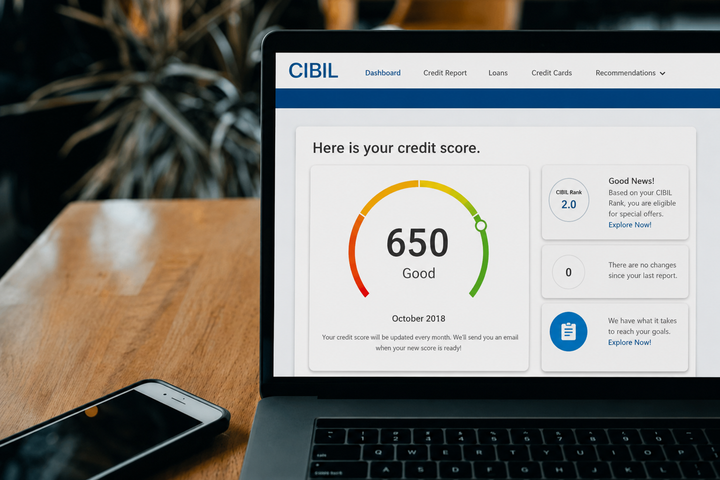
A credit information bureau (India) limited (CIBIL) score above 700 improves approval chances. a lower score may still qualify, but terms may vary.
age
minimum 21 years for the primary applicant and 18 years for co-applicants. maximum age is typically 70 years.
special cases
top up on other loans
top-up loans are also available on car loans. Bajaj Finance offers up to 180% of the car's value at competitive rates.
gold loan top ups
gold loan top-ups are available for existing borrowers with a standard account. the maximum top-up depends on the gold's current valuation and RBI's tiered LTV limits. eligibility is based on the borrower's formal request, standard account classification, credit assessment, and permissible LTV.
the RBI's tiered LTV limits for gold loans are:
- up to ₹2.5 lakh: 85%
- ₹2.5 to 5 lakh: 80%
- above ₹5 lakh: 75%
watch out for these
LTV limits are non-negotiable
RBI caps LTV at 75 to 90% depending on the total loan amount. do not exceed these limits.
avoid long tenures
limit the tenure of top-up loans to 2 to 4 years. extending beyond this increases total interest without adding value.
don't over-leverage
a top-up increases total debt. if property value falls or income declines, the enhanced EMI can become unmanageable.
use it only for mandatory expenses
fund essential needs: renovation, medical, education, or debt consolidation. avoid speculative uses.
frequently asked questions
1. how much top up loan can I get on my home loan?
the amount depends on property value, outstanding balance, and lender LTV. Bank of Baroda offers up to ₹2 crore. South Indian Bank's calculation shows ₹37.5 lakh top-up on a ₹1 crore property with ₹40 lakh outstanding.
2. what is the LTV ratio for top up loans?
90% for total loans up to ₹30 lakh, 80% for ₹30 to 75 lakh, and 75% for above ₹75 lakh. most lenders cap total loan at 70 to 80% of property value.
3. what is the minimum CIBIL score for a top up loan?
no fixed universal minimum. most lenders require a clean repayment track record for 6 to 12 months. a higher score above 700 improves approval chances.
4. how is top up loan eligibility calculated?
top-up = (Property Value × LTV Cap): Outstanding Loan Balance. for a ₹1 crore property with ₹50 lakh outstanding and 80% LTV: top-up = ₹30 lakh. lenders also consider FOIR, credit score, and age.
5. can a top up loan be taken without collateral?
a home loan top-up requires the same property as collateral since it is an extension of the mortgage. gold loan top-ups use the already-pledged gold, with no additional collateral required.