how do debt consolidation loans work?

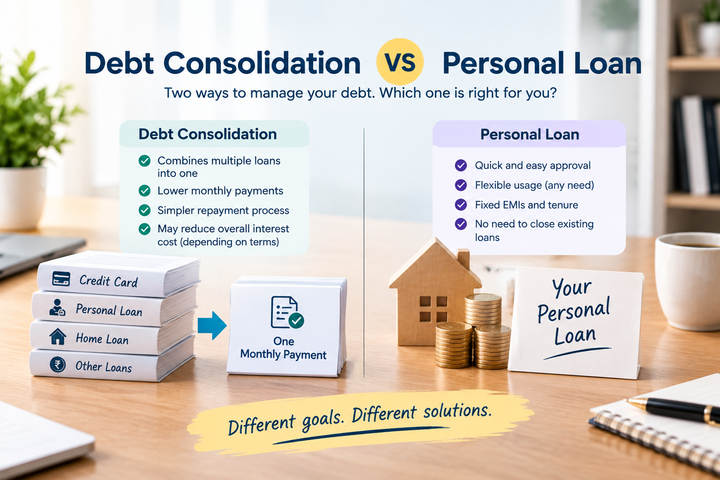
debt consolidation merges several loans into one. instead of tracking multiple EMIs with different due dates and rates, the borrower makes a single monthly payment. the aim is to simplify repayments and potentially lower the interest cost.
the total debt does not disappear. it gets rearranged. the borrower takes a fresh loan, clears all existing dues, and then repays the new loan over a fixed period.
how the process works
the borrower applies for a loan that covers the total outstanding across all existing debts. once approved, the lender releases the funds. the borrower settles credit cards, personal loans, and other obligations. after that, only one loan remains the consolidation loan.
this cuts down the paperwork and tracking. one due date replaces five. one interest rate replaces five.
when consolidation makes sense
consolidation works when the new rate is lower than the average rate on current debts. credit card debt is the strongest case. cards charge 36% to 42% per year. a personal loan for consolidation usually costs 12% to 14%. the difference is meaningful.
a ₹3 lakh credit card balance at 36% costs ₹9,000 per month in interest. the same amount at 12% on a personal loan costs ₹3,000 per month. that is ₹6,000 saved every month.
consolidation also helps when managing multiple equated monthly instalments (EMIs) becomes overwhelming. a single payment reduces the chance of missing due dates and incurring late fees.
consolidation options
personal loan. this is a common route. the borrower takes a fresh personal loan and clears existing debts. interest rates typically range from 12% to 24%. tenures run from 12 to 60 months.
loan against property. for larger amounts, this option offers lower rates, usually 9% to 11%. the loan can go up to 70% to 75% of the property's value. tenures extend to 15 years. this suits borrowers with significant debt and property to offer as security.
top-up home loan. existing home loan borrowers can use a top-up loan to consolidate. the rate is typically 0.5% to 1% above the home loan rate. this is often the cheapest option for those who already have a home loan.
gold loan. for moderate debt, a gold loan can clear high-interest dues. no credit score check is required. rates range from 9% to 24%. tenures are shorter, usually 6 to 24 months.
what lenders evaluate
lenders check several factors before approving a consolidation loan.
credit score. most lenders prefer 750 or above for the best rates. some accept 650, though rates are higher.
income stability. a steady income with enough room for the new EMI is essential. lenders calculate the debt-to-income ratio to check this.
existing debt levels. if total EMIs already exceed 50% of monthly income, approval becomes harder. reducing some debt before applying improves the chances.
repayment track record. a history of timely payments on existing loans strengthens the application.
how the EMI changes
the monthly payment on a consolidation loan depends on three factors: the loan amount, the interest rate, and the tenure.
a ₹5 lakh loan at 12% for 3 years has an EMI of roughly ₹16,600. stretching it to 5 years brings the EMI down to about ₹11,100. the monthly payment drops by ₹5,500, but total interest rises.
the borrower needs to decide what matters more a lower monthly payment or a lower total cost.
what to check before applying
total cost. a lower EMI with a longer tenure costs more in total interest. comparing the total repayment amount gives the true picture.
processing fees. most consolidation loans charge 1% to 3% of the loan amount. this adds to the upfront cost.
prepayment charges. closing existing loans early may attract penalties. the exit cost should be weighed against the savings from the new loan.
eligibility. each lender has different criteria. some require a minimum income of ₹25,000 per month. others have lower thresholds.
frequently asked questions
1. does debt consolidation reduce the total amount owed?
the total amount owed does not change. the loan is structured differently to make monthly payments more manageable.
2. what is the minimum credit score for a consolidation loan?
most lenders prefer 750 or above. some accept scores as low as 650, but at higher interest rates.
3. can credit card debt be consolidated into a personal loan?
this is a common use of consolidation. personal loan rates are significantly lower than credit card rates.
4. how long does debt consolidation take?
unsecured personal loans are approved within 24 to 48 hours. secured loans against property take longer, typically 48 to 72 hours.
5. will debt consolidation affect the credit score?
initially, the hard inquiry may cause a small temporary dip. but as credit card balances are paid off and the new loan is repaid on time, the score typically improves.