debt consolidation vs personal loan: which is better for managing debt?
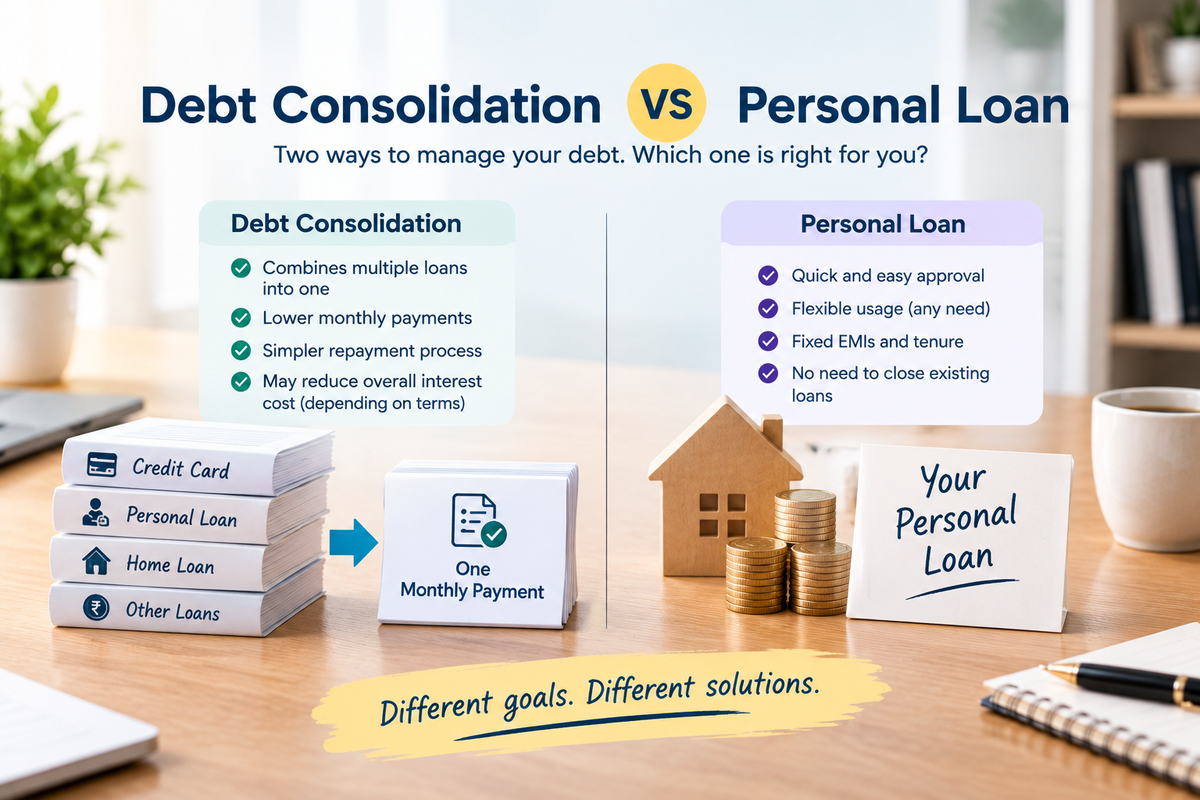
these two terms get mixed up all the time. here is the simple breakdown.
a personal loan is a product. the borrower gets a lump sum. it gets repaid in fixed EMIs. the money can be used for anything home renovation, medical expenses, travel, or even paying off other debts.
debt consolidation is a strategy. it means combining multiple debts into one single payment. the tool used to do this is often a personal loan. but consolidation can also be done through balance transfer cards, home equity loans, or even top-up home loans.
think of it this way: all debt consolidation loans are personal loans, but not all personal loans are debt consolidation loans. the difference is purpose a debt consolidation loan is a personal loan used specifically to pay off existing debts.
when a personal loan makes sense for debt repayment
using a personal loan to pay off debt can work well when the interest rate is significantly lower than existing debts.
the numbers tell the story. credit cards in India charge 30 to 42% annual interest. personal loans start around 10.5% for strong credit profiles. moving credit card debt into a personal loan can cut interest costs by more than half.
for borrowers with good credit (CIBIL 700+), a personal loan offers:
- a fixed interest rate for the full tenure
- no collateral required
- a clear payoff date
- flexibility to use the funds beyond just debt repayment
this strategy works best when the borrower has a stable income and can comfortably manage the new EMI. but underlying spending habits must change otherwise, consolidation becomes rearranging stress, not reducing it.
when debt consolidation is the better strategy
debt consolidation is a smarter choice when multiple debts with different due dates, interest rates, and lenders are being juggled. instead of tracking five different payments, there is one. instead of dealing with five lenders, there is one.
debt consolidation particularly helps when:
- high-interest credit cards are the main problem
- multiple EMIs are hard to track and manage
- a fixed payoff date is desired
- there is a genuine intention to close old accounts after clearing them
consider someone earning ₹70,000 a month. there may be a personal loan running, two credit card balances, an EMI for a smartphone, and perhaps a short-term loan. individually, each borrowing seemed manageable. together, they create a confusing monthly financial picture. one missed payment can trigger additional charges and hurt the credit profile.
debt consolidation addresses this by bundling everything into one loan, one due date, and one lender. it simplifies the structure without necessarily reducing the total debt but it makes repayment far more manageable.
the risks where both options can go wrong
extending tenure to lower EMI
a longer tenure makes the monthly payment affordable but increases total interest paid over the loan's life. a lower monthly payment feels good, but stretching repayment over many more years can dramatically increase the total amount repaid.
the fresh start trap
once credit card balances hit zero, some borrowers feel a false sense of freedom and start spending on those cards again. the result is double debt: the consolidation EMI plus new credit card bills. this is why lenders love consolidation borrowers; many come back for more credit later.
hidden costs
processing fees, prepayment charges, and other fees can wipe out the interest savings. a personal loan might offer a lower rate, but if the processing fee is 2 to 3% and the tenure is longer, the net benefit may disappear.
when income is unstable
if income is not stable, consolidation can lock the borrower into an EMI that cannot be sustained. in that case, aggressive repayments, spending cuts, or negotiating directly with lenders may work better than another loan.
how to choose
a personal loan for debt repayment makes sense when:
- the borrower has good credit (CIBIL 700+)
- flexibility is needed to use the funds for multiple purposes
- the fixed rate is significantly lower than current debts
- the borrower can commit to not accumulating new debt
debt consolidation as a strategy makes sense when:
- high-interest debt is the main problem, not overspending
- multiple debts with different due dates are being juggled
- a single EMI and a fixed payoff date are desired
- the borrower plans to close or strictly limit the cards paid off
both should be avoided when:
- income is unstable
- the new loan tenure extends beyond the problem it solves
- spending habits have not been addressed
- most debt is already at reasonable interest rates
frequently asked questions
1. what is the difference between a debt consolidation loan and a personal loan?
a personal loan is a financial product a lump sum borrowed and repaid in equated monthly instalments (EMIs). debt consolidation is a strategy using a loan (often a personal loan) to combine multiple debts into one payment. all debt consolidation loans are personal loans, but not all personal loans are debt consolidation loans. the difference is purpose: a debt consolidation loan is specifically for paying off existing debts.
2. which is better debt consolidation or paying multiple loans separately?
debt consolidation is better when it lowers the weighted average interest rate and the borrower avoids extending the tenure too much. it simplifies repayment multiple EMIs become one, with one due date and one lender. but if the tenure is extended just to reduce the monthly payment, total interest paid can rise significantly. for many, the avalanche method (paying highest-interest debt first) may be more cost-effective without taking on new debt.
3. what is the minimum CIBIL score for a debt consolidation loan?
most lenders prefer a credit information bureau (India) limited (CIBIL) score of 700 or higher for the best rates. some accept scores as low as 650 but charge higher interest rates. a strong credit profile improves approval chances and secures better terms. if the score is low, secured options like top-up home loans or loans against property are cheaper than unsecured consolidation loans.
4. can a personal loan be used to consolidate credit card debt?
using a personal loan to pay off credit card debt can be a practical option when the interest rate is lower than the effective cost of revolving credit card debt. the key is to ensure that debt consolidation leads to better financial management rather than encouraging further borrowing. borrowers should first assess their existing liabilities and repayment capacity, and maintain disciplined spending.
5. what are the risks of debt consolidation?
the main risks include extending the tenure which increases total interest, hidden fees like processing fees and prepayment charges that wipe out savings, and the "fresh start" trap where borrowers start spending on credit cards again after consolidating. if income is unstable, consolidation can lock the borrower into an EMI that cannot be sustained. borrowers should also check if the loan has prepayment penalties and whether the interest rate is fixed or floating.