how can I consolidate my debts into a single loan with lower monthly payments?

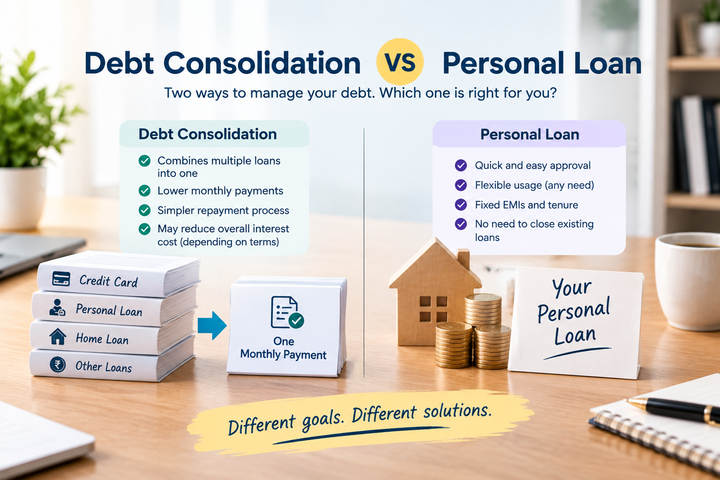
debt consolidation means taking one new loan to pay off several existing ones. the borrower stops tracking multiple equated monthly instalments (EMIs) with different due dates. one monthly payment replaces many.
the total debt does not go away. it gets rearranged. the aim is to make repayments simpler and potentially cheaper by swapping high-cost debt for a lower-cost loan.
lower monthly payments come from two things. a lower interest rate or a longer repayment period. if the new loan costs less than the old debts, the EMI drops. stretching the tenure drops the EMI further, though total interest goes up.
ways to consolidate debt
personal loan. this is a common route. the borrower takes a fresh personal loan and clears existing debts. interest rates typically range from 12% to 24%. tenures run from 12 to 60 months. this works well for credit card debt, payday loans, and smaller personal loans.
loan against property. for larger amounts, this option offers lower rates, usually 9% to 11%. the loan can go up to 70% to 75% of the property's value. tenures extend to 15 years. this suits borrowers with significant debt and property to offer as security.
top-up home loan. existing home loan borrowers can use a top-up loan to consolidate. the rate is typically 0.5% to 1% above the home loan rate. this is often the cheapest option for those who already have a home loan.
gold loan. for moderate debt, a gold loan can clear high-interest dues. no credit score check is required. rates range from 9% to 24%. tenures are shorter, usually 6 to 24 months.
how to bring down monthly payments
extend the tenure. choosing a longer repayment period brings down the monthly payment. a ₹5 lakh loan at 12% for 3 years comes to ₹16,600 per month. stretching it to 5 years reduces the EMI to ₹11,100. that is ₹5,500 less each month. the catch is higher total interest over the loan's life.
get a lower rate. a better rate reduces both the EMI and total interest. dropping the rate by 2% on a ₹5 lakh loan over 5 years cuts the EMI by about ₹500 per month. the total interest saved comes to roughly ₹30,000.
borrow less. taking only what is needed keeps both the EMI and total interest lower. adding extra funds for other purposes increases the monthly burden.
when consolidation works
consolidation makes sense when the new loan's rate is lower than the average rate on existing debts. credit cards charge 36% to 42%. personal loans charge 12% to 14%. the savings are clear.
on a ₹3 lakh credit card balance at 36%, the monthly interest alone is ₹9,000. the same amount at 12% on a personal loan costs ₹3,000 in monthly interest. that is ₹6,000 saved per month.
what to check before applying
credit score. most lenders prefer 750 or above for the best rates. some accept 650, though rates are higher.
processing fees. most consolidation loans charge 1% to 3% of the loan amount. this adds to the upfront cost.
prepayment charges. closing existing loans early may attract penalties. the exit cost should be weighed against the savings from the new loan.
total cost. a lower EMI with a longer tenure costs more in total interest. comparing the total repayment amount gives the true picture.
eligibility. each lender has different criteria. some require a minimum income of ₹25,000 per month. others have lower thresholds.
frequently asked questions
1. what is the best way to consolidate debt and lower monthly payments?
a personal loan with a lower rate and a longer tenure works well. for larger amounts, a loan against property offers even lower rates and longer tenures.
2. does debt consolidation reduce the total amount owed?
the total owed does not change. the loan is structured differently to make monthly payments more manageable.
3. what credit score is needed for a consolidation loan?
most lenders prefer 750 or above. some accept 650, but at higher rates.
4. can credit card debt be consolidated into a personal loan?
this is one of the most common uses of consolidation. personal loan rates are much lower than credit card rates.
5. how long does consolidation take?
unsecured loans are approved within 24 to 48 hours. secured loans take longer, typically 48 to 72 hours. the timeline depends on documentation completeness.