what documents do I need to apply for a top-up loan and how long does the approval process take?
a top-up loan is additional money from the existing lender on top of the current loan. the borrower does not apply to a new bank. the borrower goes back to the same lender who already provided the home loan, car loan, or personal loan.
the interest rate on a top-up loan is usually lower than a personal loan. it is higher than the original home loan rate. typically 1% to 2% above the existing rate.
the big advantage is no new collateral. the home or car already secures the original loan. the top-up uses the same collateral.
the process is shorter than a fresh loan. the lender already has the borrower's know your customer (KYC) and income documents from the original application. approval takes anywhere from a few hours to a few days depending on the loan type.
understanding what lenders look for is the first move. comparing the terms comes next. checking the total cost follows. taking the loan only if the terms work is the final step.
what lenders check before approving
lenders evaluate three things before approving a top-up loan.
repayment history. the lender checks whether the borrower has paid equated monthly instalments (EMIs) on time for the last 12 to 24 months. a clean record means approval is likely. missed payments mean the lender may say no.
remaining loan amount. a top-up loan is not available if the original loan is almost finished. most lenders want at least 2 to 3 years of loan tenure remaining. they need time to recover the additional money.
property value for home loans. the lender checks if the property value has gone up. if it has, they can offer a top-up. if property prices have fallen, they may reduce the amount or reject the application.
income. the lender checks if income has increased since the original loan. higher income means the borrower can handle higher EMIs. if income has dropped, approval becomes difficult.
borrowers who meet these criteria move through the process quickly. those who do not may face rejection or higher rates.
documents required for a top-up loan
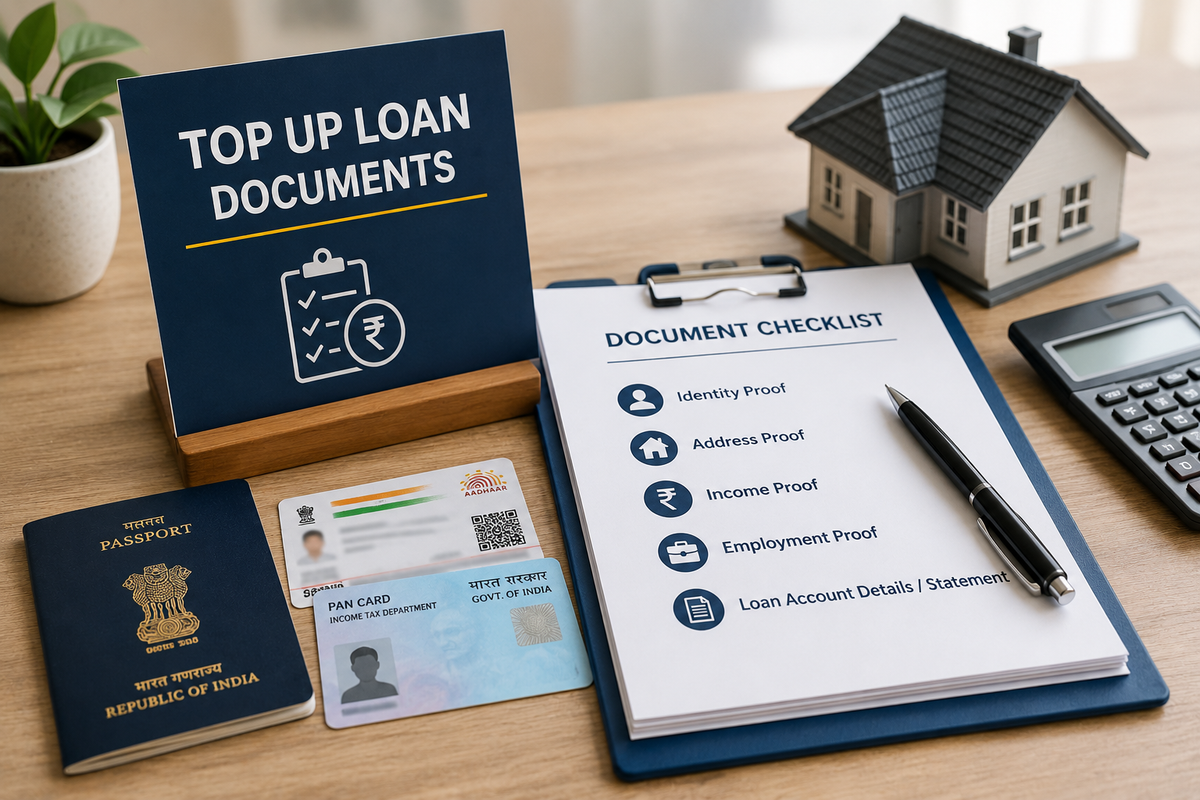
the document list for a top-up loan is shorter than a fresh loan. the lender already has the borrower's KYC and income documents from the original application.
identity proof. PAN card is mandatory. Aadhaar or voter ID works as secondary proof.
address proof. Aadhaar usually covers this. if the Aadhaar address is old, a recent utility bill or rent agreement works.
income documents for salaried borrowers. last 2 to 3 months of salary slips. last 6 months of bank statements showing salary credits.
income documents for self-employed borrowers. last 2 years of IT returns. last 6 months of bank statements for the business account.
loan statements. this is unique to top-up loans. the lender wants to see the repayment history on the existing loan. the borrower does not need to submit this separately. the lender has it in their system. they check internally.
property documents for home loan top-up. if the original loan is a home loan, the lender may ask for updated property documents. they want to make sure the property value has not dropped. this is rare for small top-ups but common for large amounts.
some lenders ask for additional documents. income tax returns for self-employed borrowers. business registration proof. these depend on the lender and loan amount.
how long does approval take
approval is faster than a new loan. slower than a credit card withdrawal.
home loan top-up. approval takes 3 to 7 days. the lender needs to reassess property value and repayment capacity.
personal loan top-up. approval takes 1 to 3 days. faster because there is no property involved.
pre-approved top-up. money can reach the account in a few hours. many lenders offer pre-approved top-up loans to customers who have paid 12 to 24 months of EMIs on time. checking the lender's app shows whether this option is available.
how much can be borrowed
the loan amount depends on the original loan and property value.
typically up to the difference between the original loan amount and the current outstanding principal.
a simple example. a borrower took a home loan of ₹50 lakh. they have repaid ₹10 lakh so far. the outstanding principal is ₹40 lakh. the lender may offer a top-up of up to ₹10 lakh. this brings the total loan back to ₹50 lakh.
some lenders go higher if the property value has increased. if the ₹50 lakh property is now worth ₹70 lakh, the borrower may get a top-up of ₹15 to ₹20 lakh.
for personal loan top-ups, the amount is usually smaller. ₹1 lakh to ₹5 lakh depending on income and repayment history.
borrowing only what is needed is the smarter move. taking extra increases the EMI and the total interest. the top-up is a one-time need. the loan repayment lasts for years.
interest rates on top-up loans
interest rates are lower than a personal loan. higher than the original home loan.
if the home loan is at 8.5%, a top-up loan on that home loan will be around 9.5% to 10.5%. if the borrower took a personal loan from the same bank at 12%, a top-up on that personal loan will be around 13% to 14%.
the exact rate depends on repayment history and current income.
processing fees range from 0.5% to 1% of the top-up amount. some lenders charge a flat fee. these are deducted from the disbursed amount or added to the loan.
prepayment charges apply if the borrower repays early. the borrower should check these terms before signing.
what to watch out for
a few things can go wrong.
extended tenure. a top-up loan extends the loan tenure. the borrower adds more years to the repayment schedule. if they were 5 years away from being debt-free, a top-up loan can push that to 7 or 8 years. the total interest paid increases significantly.
processing fees. the lender may charge a processing fee. usually 0.5% to 1% of the top-up amount. the borrower should ask about this before applying.
loan agreement restrictions. some older loans have restrictions on top-ups. the borrower should check the original loan agreement or call the lender's customer service.
borrowing more than needed. the lender approves a certain amount. the borrower does not have to take the full amount. taking extra increases the EMI and the total interest.
ignoring fees. the interest rate gets the most attention. processing fees, prepayment charges, and late payment penalties add to the cost. comparing the annual percentage rate, or annual percentage rate (APR), across lenders gives a more accurate picture.
not checking the credit score beforehand. the borrower should check the credit information bureau (India) limited (CIBIL) score before applying. errors on the report are common. correcting them can improve the score and the loan terms.
frequently asked questions
1. can I get a top-up loan from a different lender
no. a top-up loan comes only from the existing lender. if money is needed from a new bank, the borrower needs a fresh personal loan or a loan transfer.
2. does a top-up loan affect my CIBIL score
the lender runs a hard enquiry before approving, which typically costs roughly 5 to 10 points on the score. paying the new EMIs on time helps the score recover and improve from there.
3. what happens if I default on a top-up loan
the lender has the same rights as the original loan. for a home loan top-up, they can seize the property. for a personal loan top-up, they can take legal action and report the default to credit bureaus.
4. can I take multiple top-up loans on the same account
some lenders allow a borrower to take a top-up, repay part of it, and take another top-up later. each application triggers a fresh hard enquiry on the credit report, and several enquiries in a short window signal repeated borrowing to other lenders.
5. can I get a top-up loan if my original loan is almost finished
usually not. most lenders want at least 2 to 3 years of loan tenure remaining. they need time to recover the additional money.