can I get a personal loan with a low CIBIL score?
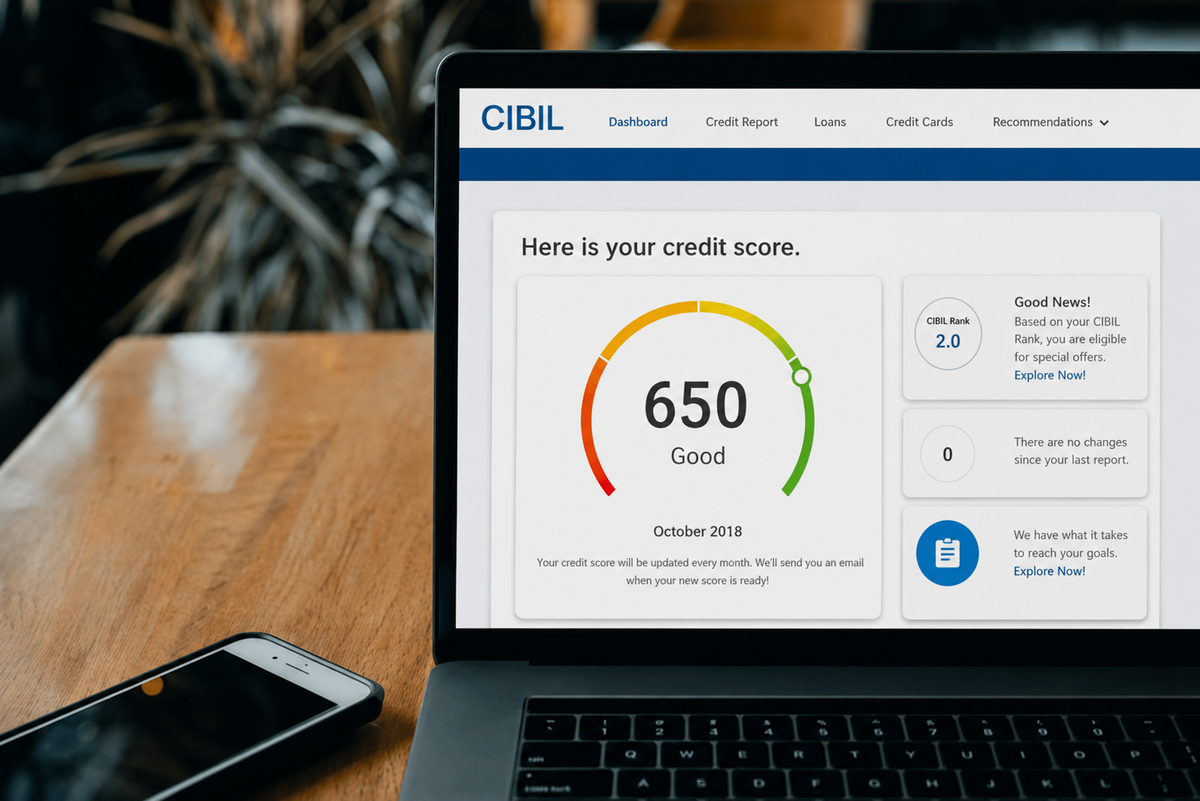
a personal loan with a low CIBIL score is possible, and what changes is the offer rather than the answer. a score of 550, 580, or 620 still finds lenders, though the interest rate moves up, the sanctioned amount comes down, the tenure shortens, and the number of lenders willing to look at the file gets smaller.
most Indian lenders treat 750 and above on the 300 to 900 CIBIL scale as prime. between 650 and 750 the decision rests on other factors such as income stability, employer reputation, and existing monthly obligations. below 650 the pool of lenders narrows noticeably, and those who remain either charge substantially more or ask for security against the loan.
the more useful question is not whether some lender will approve the application, but whether the monthly budget can absorb the new EMI at the rate that lender offers. that single calculation decides whether the loan solves a problem or adds a recurring one.
every rate, band, and amount in this article is indicative. actual terms depend on the lender, the income profile, and the credit report, and they need confirmation from the lender before any agreement is signed.
what counts as a low CIBIL score for a personal loan
| score band | how lenders read it | indicative effect on a personal loan |
|---|---|---|
| 750 to 900 | prime | the widest choice of lenders, with rates around 11% to 13% per annum for a salaried applicant. |
| 650 to 750 | moderate | approval depends on income stability, employer profile, and existing EMIs rather than on the score alone. |
| below 650 | low for unsecured lending | fewer lenders participate, rates run higher, and some ask for collateral, a co-applicant, or a guarantor. |
the CIBIL score is a summary of credit history and a statistical estimate of how likely a borrower is to repay on time. it is not a verdict on character, and lenders use it as a first filter because reviewing every application manually would take too long.
what pulls a CIBIL score down
a low score usually traces back to one or more specific entries on the credit report.
- missed or delayed payments on earlier loans or credit cards, which carry the most weight on the report.
- credit utilisation above 40% of the available limit, and in many cases well above that level.
- several loan applications within a short period, since each one leaves a hard inquiry on the report.
- a credit history shorter than two years, which gives the model too little repayment data to work with.
- accounts marked as settled or written off, which stay on the report for years.
none of these alone disqualifies a borrower, and each one makes a lender more cautious. how that caution translates into rate, amount, and tenure is what shapes the final offer.
how the offer changes with a low CIBIL score
| what the lender adjusts | what it looks like in practice |
|---|---|
| interest rate | an applicant at 750 sees roughly 11% to 13% per annum, while an applicant at 620 may be quoted 16% to 20% or more. moving from about 11% to about 16% on a ₹5 lakh loan over 3 years adds roughly ₹40,000 to ₹50,000 in interest and raises the EMI by about ₹1,000 to ₹1,200. |
| loan amount | someone earning ₹60,000 a month with a strong score might be approved for ₹10 lakh, and the same income at a 620 score often draws an offer of ₹3 lakh to ₹5 lakh. the income has not changed, only the margin of safety the lender wants. |
| tenure | a five-year repayment period is often cut to three years, which raises the EMI and shortens the period the lender stays exposed. |
| co-applicant or guarantor | many lenders ask for a co-applicant with a stronger credit profile, or a guarantor who becomes responsible on default. public sector banks apply this most often. |
| security | a personal loan is normally unsecured, and at a low score some lenders approve it only against collateral such as a fixed deposit, gold, or property, which changes the nature of the borrowing. |
these adjustments are risk management rather than penalty. the lender is protecting its own recovery position, and the cost of that protection sits on the borrower side of the agreement, which is why the total repayment across the tenure is worth working out before accepting an offer.
which lenders approve a personal loan with a low CIBIL score
| type of lender | how a low score is treated |
|---|---|
| public sector banks | the strictest of the group, with approval below 650 difficult. a long-standing salary account holder occasionally gets through, and these remain exceptions rather than a route to rely on. |
| private banks and NBFCs | more flexible, weighing income stability, employer reputation, and the existing banking relationship. a low score alongside a stable salary and a long relationship can still result in approval. |
| fintech lenders | some assess alternative data such as bank statements, spending patterns, utility payments, and rent payments, so the CIBIL score forms part of the decision without deciding it. rates are higher and processing is faster, sometimes within hours. |
| lenders targeting low-score borrowers | a small segment lends specifically at higher rates, smaller amounts, and shorter terms. not all of them are registered with the RBI, and not all disclose fees clearly, so verification before applying matters here more than anywhere else. |
| regulated marketplaces | platforms such as Cash By CRED show offers from multiple partner lenders together, so eligibility and terms can be compared before a single full application goes in. |
applying to lenders whose published criteria match the profile is what keeps the score intact. every application triggers a hard inquiry that drops the score slightly, and a cluster of inquiries in a short window reads as distress to the next lender who sees the report.
checking the CIBIL report before applying with a low score
the CIBIL report is available on the official CIBIL website and through partner platforms, and it lists every loan account, credit card, payment record, and inquiry along with the score. reading it before applying shows exactly which entries are holding the score down.
errors on credit reports are common. a closed loan still showing as active, a payment made on time but recorded as late, and an account belonging to someone else because of a name mismatch all appear regularly, and the dispute resolution process takes about 30 days with the score often improving within weeks of a correction.
after the corrections, the debt itself is the next lever. utilisation above 40% of the available limit is read as a risk signal, and bringing it below 30% helps the score recover quickly. settled or written-off accounts remain on the report for years, though a consistent record of on-time payments after that settlement carries weight with lenders. six months of on-time payments, low utilisation, and no new applications can move a borderline score into a better band, and the rate saved often exceeds the cost of waiting.
documentation matters more with a low CIBIL score
when the score is weak, lenders look for compensating evidence, and that evidence sits in the documents. salary slips from the last six months establish income stability, bank statements with regular inflow and manageable outflow show repayment capacity, ITR filings from the last two years confirm declared income, and statements of existing loans paid on time build a positive record that runs alongside the score.
a soft inquiry, such as checking one's own score or viewing a pre-approved offer the lender has already generated, leaves the score untouched. a full application is a hard inquiry that can lower the score by roughly 5 to 10 points and stays on the report for two years, and several in a short span have a larger effect. because some lenders present a full application as an eligibility check, it is worth confirming whether a given check is a soft inquiry before proceeding rather than assuming it is.
signs of predatory lending to watch for
borrowers with low scores are actively targeted, and certain patterns identify a lender operating outside RBI norms.
- approval guaranteed without any document check, which no regulated lender can offer.
- fees demanded before disbursal, whether described as processing, insurance, or verification charges.
- no registered entity name or physical address anywhere on the website or app listing.
- pressure for an immediate decision, often with a countdown or an expiring offer.
- interest rates and fees that are never stated in writing before signing.
banks and registered NBFCs appear on the RBI website, and checking that list takes about five minutes. a rejection from a registered lender leaves the borrower in a better position than an approval from an unregistered one.
alternatives to a personal loan with a low CIBIL score
| option | indicative cost | what applies |
|---|---|---|
| gold loan | from around 9% to 10% per annum at most public sector banks | secured against jewellery, so the CIBIL score carries less weight, rates are lower than unsecured lending at a low score, and processing is faster. |
| loan against a fixed deposit | lower than an unsecured personal loan rate | no CIBIL check, with the amount usually 80% to 90% of the deposit value, and often the cheapest route for a low-score borrower who already holds a deposit. |
| credit builder loan | small amounts over a short period | designed to create repayment history, reported to CIBIL, and successful repayment improves the score for future borrowing. |
| peer-to-peer lending | rates vary widely by platform and lender | platforms are regulated by the RBI, approval does not rest on the CIBIL score alone, and both risk and cost run higher than a bank loan. |
| waiting and improving the score | no borrowing cost | a score of 680 draws materially better terms than 620, and on a large loan the interest saved can outweigh the delay. |
a low CIBIL score does not make a personal loan impossible. whether the loan is worth taking at the terms actually offered is the question that deserves the closer look, since the same shortfall can often be covered at a lower cost through a secured option or a short wait.
frequently asked questions
what is a low CIBIL score for personal loans
scores below 650 on the 300 to 900 scale are generally treated as low for unsecured personal loans. the 650 to 750 range counts as moderate, and anything above 750 sits in prime territory where the widest set of lenders competes.
can I get a personal loan with a 600 CIBIL score
select lenders do approve applications at 600, and the terms reflect the risk with a higher interest rate, a smaller sanctioned amount, and a shorter tenure than a higher score would attract. a co-applicant with a stronger profile or collateral improves both the approval odds and the rate.
does checking my CIBIL score affect my credit
checking one own score is a soft inquiry and leaves the score unchanged. applying for a loan triggers a hard inquiry, which lowers the score by a few points and remains visible on the report for two years.
what documents are needed for a personal loan with a low CIBIL score
salary slips, bank statements, ITR filings, and identity proof form the base set. statements of existing loans showing payments made on time strengthen the application, because they demonstrate current repayment behaviour that the score may not yet reflect.
how long does it take to improve a CIBIL score
payments made on time along with utilisation kept below 30% usually show improvement within 3 to 6 months. errors on the report can be corrected within about 30 days through the dispute resolution process, which is the faster of the two routes when an error is the cause.